Diurnal variations
Introduction
By day, the ground (and so the air near it) warms as the surface absorbs
heat from sunlight. When the Sun goes down, the ground cools by
re-radiating that heat to “cold space”, thus cooling the
adjacent air. This diurnal cycle of radiative heating and cooling of the
surface drives changes in the atmospheric
boundary layer
that cause corresponding diurnal changes in atmospheric refraction.
Here's an example of the change in the temperature profile in an average
April day,
measured
by W. D. Flower at Ismailia, Egypt (near the
Suez Canal).
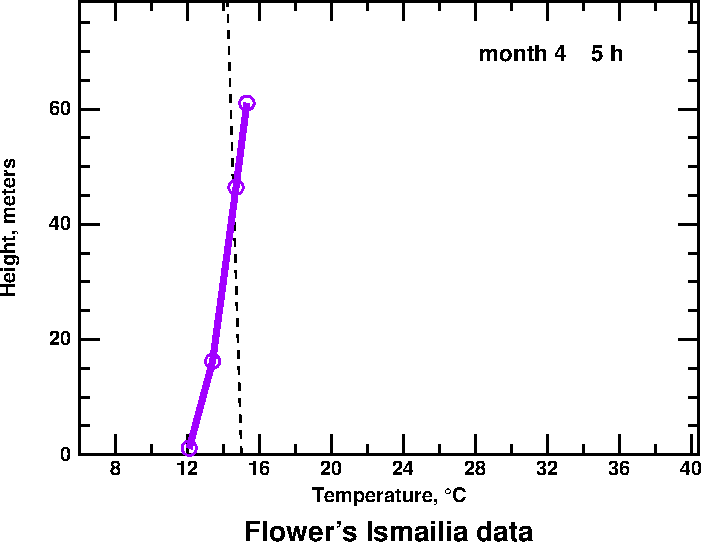 On the left you have the mean temperature profile for 5 a.m., just
before sunrise. The lowest 60 meters of the nocturnal atmosphere are
thermally inverted, and very stable: the
Standard Atmosphere
profile (shown dashed) slopes the
opposite way from the measurements, and is bent, not straight.
On the left you have the mean temperature profile for 5 a.m., just
before sunrise. The lowest 60 meters of the nocturnal atmosphere are
thermally inverted, and very stable: the
Standard Atmosphere
profile (shown dashed) slopes the
opposite way from the measurements, and is bent, not straight.
Flower's data show even more extreme differences if only clear nights are
averaged. The Standard Atmosphere is obviously a poor model to use for
calculating astronomical refraction.
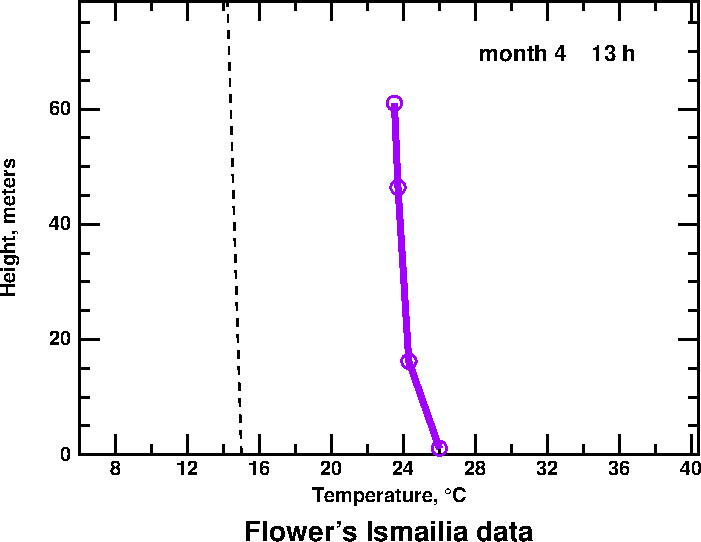 But at 1 p.m. the atmosphere is convective. The air near the ground
has more than ten times the adiabatic lapse rate, and only the air above
15 meters has about the same slope as the Standard Atmosphere.
But at 1 p.m. the atmosphere is convective. The air near the ground
has more than ten times the adiabatic lapse rate, and only the air above
15 meters has about the same slope as the Standard Atmosphere.
These two images are frames from an
animation
of the Ismailia measurements.
Air itself absorbs very little heat from sunlight. So very little of its
temperature change is due to sunlight directly; the variations are mostly
due to temperature changes of the Earth's surface, which absorbs most of
the solar energy. Because heat conduction in air is very weak, these
surface temperature changes move up through the boundary layer mainly by
turbulent mixing.
Unfortunately, boundary-layer turbulence is a complicated problem that
depends on wind shear, surface roughness and slope, and stability.
Stably-stratified layers can isolate the air above them from fluctuations
at the surface. So we cannot predict the diurnal variations in a simple
way. However, some general principles allow us to get a partial
understanding of this complex situation.
Let's look at the various pieces separately.
Radiative heating and cooling
Every surface at thermodynamic temperature T radiates heat at a rate
that's proportional to T 4. Thermodynamics tells
us that the emission must balance the absorption — otherwise we
could make a perpetual-motion machine — and that there is a maximum
emission from a perfectly absorbing surface that would appear perfectly
black: an idealized “black body”.
Black-body radiation extends over the whole electromagnetic spectrum, but
is concentrated in a couple of octaves around a wavelength that is
inversely proportional to the temperature T. At room temperature
(a little below 300 K), the middle of this interval is in the
“thermal infrared”, near 14 microns wavelength. On the other hand, the
Sun's effective temperature is a little less than 6000 K, and its
thermal radiation is centered near 0.7 microns, at the red end of the
visible spectrum. Notice that the ratio of temperatures is about 20, and
so is the ratio of middle wavelengths.
How black are real surfaces? Most surfaces are pretty black. The
blackness of a real surface is measured by its emissivity, usually
denoted by the letter ε, which is 1 for the perfect black body. The
emissivity depends on wavelength; so the effective emissivity of a
surface depends on its temperature, because most of its thermal radiation
is at wavelengths that change with the temperature.
Thermal emissivities for real surfaces near 300 K are usually close
to 1, so a rough calculation can ignore this issue. In particular,
organic materials like plant leaves and plastics and paint are nearly
perfect absorbers and emitters at ordinary temperatures, because the
hydrogen atoms in their molecules absorb at vibrational wavelengths in the
thermal infrared. (That means that white paint, water and ice, and snow
can be treated as black surfaces for our thermal work here.) Some
polished metal surfaces, on the other hand, are so nearly perfect
reflectors that they can be treated as nearly “white” for thermal
radiation. That's why the mirrors of infrared telescopes are usually
gold-coated.
So the incoming (visible) sunlight that heats the Earth's surface is
mostly absorbed, unless the surface is clean (fresh) snow. And the
thermal radiation from the surface is mostly transmitted by the
atmosphere.
Some numbers
Let's see how much radiation comes in, and how much goes out. In a steady
state, these must be equal.
The radiated power per unit area from a black surface at temperature
T is about
5.67 × 10⁻⁸ W · m−2 ·
T 4
for T in kelvins; so at 300 K, about 460 watts per square
meter is emitted by the Earth's surface, day and night, if its temperature
is that warm (about 27°C or 80°F).
That overestimates the net radiative loss of the surface, because the
infrared opacity of the air makes the sky appear to be roughly 250 K,
so that at least half of the outgoing radiant heat is returned by the
atmosphere. Maybe 200 W per square meter is a more realistic net loss.
But the daytime solar radiation is much bigger. If the Sun were at the
zenith, some 1360 watts per square meter would reach the top of the
atmosphere, and about a kilowatt per square meter would reach the ground.
However, in most places the Sun is never at the zenith; and even where it
sometimes is (in the tropics), it's only there momentarily on one or two
days a year. So we need to consider the Sun's zenith distance.
Effect of solar Z.D.
There are two different effects that need to be included. One is the
geometric effect of spreading a square meter cross section of sunlight
over more than a square meter when its light does not fall squarely on the
Earth's surface. That's Lambert's cosine law at work: the power per unit
area falling on the surface is proportional to the cosine of the Sun's
zenith distance. (A beam of sunlight one square meter in cross-section is
spread over more than one square meter when it falls on the surface
obliquely.)
The second effect is attenuation of the beam of sunlight by atmospheric
absorption and scattering. If the attenuation were the same throughout
the spectrum, the transmission of the atmosphere would just decline
exponentially with increasing airmass. But in reality, the absorption is
concentrated in molecular bands, and the scattering varies with
wavelength; the radiation in the absorption bands is removed high in the
atmosphere, leaving mostly the radiation in the more transparent spectral
regions to be absorbed near the ground. So the attenuation decreases more
slowly with increasing airmass. That's known as the “Forbes effect”,
after J. D. Forbes, the man who pointed this out in his
Bakerian Lecture
(1842).
The Forbes Effect is important for precise calculations, especially at
large airmasses. But here, we are being rather sloppy and not trying for
high accuracy; and we are also not concerned with large zenith distances.
So I'll just assume a transmission of about 0.7 per airmass, and even
approximate the airmass by sec Z. That makes the transmission at
some zenith distance Z equal to
exp(− 0.36/cos Z) .
Example: solar heating at 30° altitude
The transmission is about 0.5 when the Sun is 30° above the horizon, where
Z = 60°, and the airmass is about 2.
The geometric effect is proportional to cos Z, which is 0.866 when
Z is 60°.
The two effects (geometric and extinction) together make the power per
unit area about 1360 × 0.5 × 0.866 = 590 watts per square
meter — considerably larger than the cooling rate of the surface.
So the Sun must be lower in the sky than 30° above the horizon to
compensate the cooling of the surface exactly.
Why should we care where the Sun is when its heating just balances the
radiative loss of heat at the surface? Because that's when the surface
layer switches from stable to unstable in the morning, and from unstable
to stable in the evening.
Transition
Because the solar heating rate of the surface when the Sun is well above
the horizon is much larger than the surface cooling rate at night, and the
total daytime heating must balance the nighttime cooling, the transition
between heating and cooling must occur when the Sun is some distance above
the horizon. The calculation above shows that this must be less than 30°.
A lower limit to the Sun's altitude at transition can be found by assuming
that heat is rapidly distributed over the whole surface of the Earth.
Assume the planet is a sphere of radius R. It receives a beam of sunlight
equal to its cross-sectional area, which is πR2, but radiates
the absorbed heat from the whole surface area, which is
4 πR2. Then the balance between incoming and outgoing
radiation would occur when the Sun is low enough in the sky to spread one
square meter of beam cross-section over 4 square meters of a horizontal
surface. That requires the sine of its altitude to be 1/4 = 0.25, which
would make the altitude about 14.5°.
But we know that the heating is not distributed evenly over the surface.
So a better estimate of the Sun's altitude at crossover would be found by
treating the heat exchange as restricted to a particular latitude zone.
The area of a narrow zone of latitude is proportional to the width of its
projection on a plane perpendicular to the incoming solar radiation; at
the equator, that's just the diameter of the Earth. But the cooling
occurs over the circumference of the zone, which is π times larger. So at
low latitudes, the crossover occurs when the sine of the Sun's altitude is
1/π, making the altitude about 18.6°.
At some latitude φ, the area of the zone is increased by the secant of the
latitude. So the solar heating per unit area is decreased by this factor,
but the cooling rate is increased by it. That explains (roughly) the
decrease in average daily temperature from the equator to the poles. But
it doesn't change the day/night ratio, which remains the same (apart from
neglected effects like the increase in atmospheric extinction with solar
zenith distance, and the meridional transport of heat by winds). So the
crossover solar altitude remains about the same, except near the poles.
As the diurnal motion is about 15° per hour of time, that would put the
transitions a little over an hour after sunrise, and before sunset.
Consequently, the surface layer has an inverted lapse rate more often than
not — contrary to the unrealistic “Standard Atmosphere” models.
Observations of crossover
The transitions are readily apparent to an attentive observer. For
example, the surface wind is largely due to variations in surface
temperatures, so the wind tends to die down about an hour before sunset.
I noticed this as a boy: the hour before sunset was the best time to fly
hand-launched gliders outdoors. Later, the reduced temperature contrast
between air and surface was noticed by people studying the effects of
turbulence on laser beams: the hour before sunset was when the turbulent
scintillations were smallest.
Quantitative temperature profiles show the effect as well. The literature
on crossovers was reviewed in 2020 by
W. M. Angevine, J. M. Edwards, M. Lothon,
M. A. Lemone, S. R. Osborne
“Transition periods in the diurnally-varying atmospheric boundary layer
over land”
Boundary-Layer Meteorology , 177,
No. 2–3, pp. 205–223 (2020)
which is available at DOI: 10.1007/s10546-020-00515-y
They point out that the morning crossover occurs sooner than expected,
because part of the heat that destroys the nocturnal inversion comes from
entrainment, particularly when strong wind shear produces mixing.
Copyright © 2008, 2012, 2025, 2026 Andrew T. Young
Back to the ...
main mirage page
GF simulations page
or the
GF pictures page
or the
or the
GF home page